
Contributing to a Nature-positive Society

Employees, Local Communities, Global Environment




Basic Approach
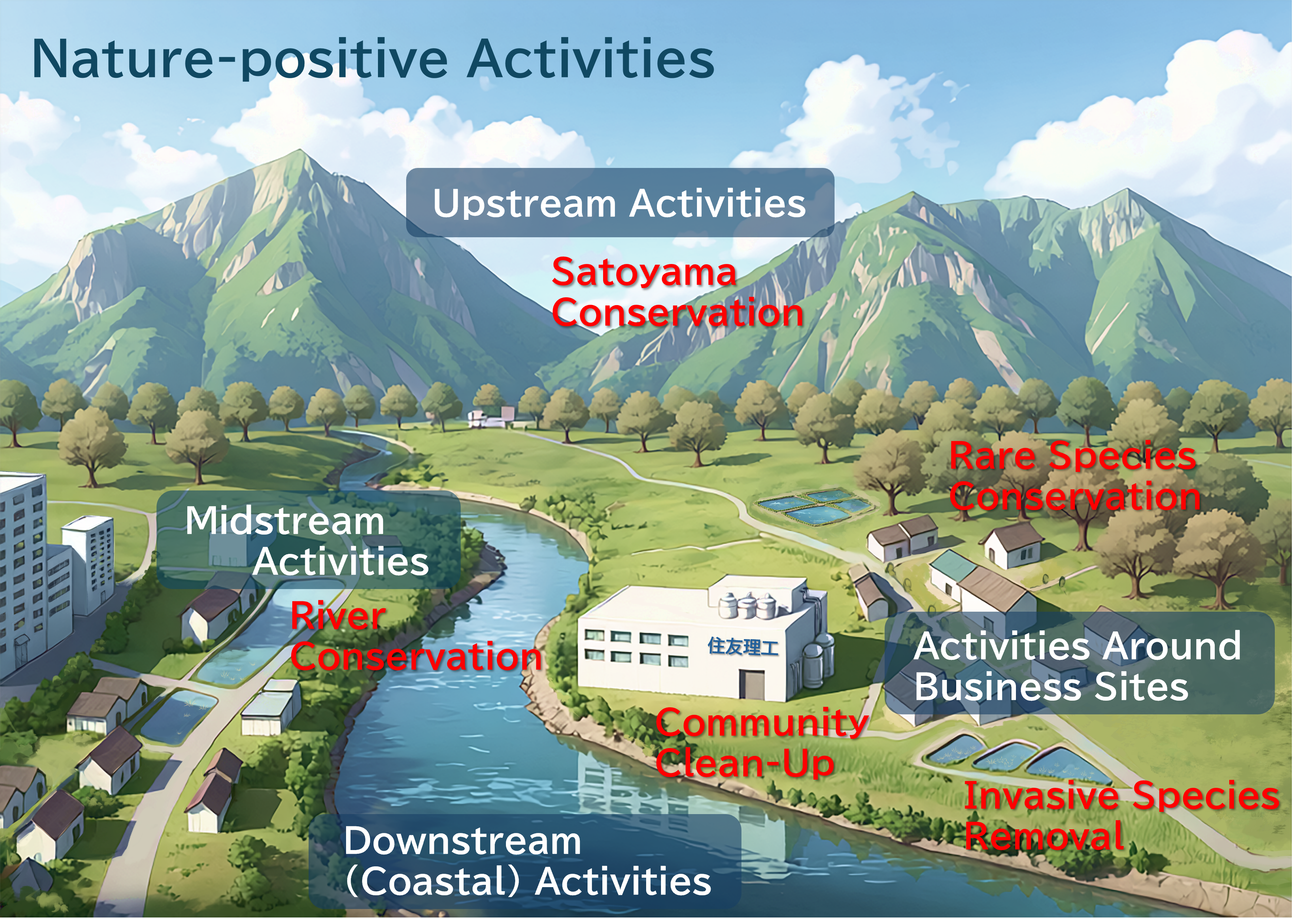
The Sumitomo Riko Group conducts its business activities using a wide range of natural resources, including natural rubber, air, water, and minerals. Recognizing our responsibility to pass these natural resources on to future generations without degrading or depleting them, we have positioned the achievement of a nature-positive society as a key goal of our Long-Term Environmental Vision 2050.
To support this goal, we are engaged in biodiversity initiatives, including satoyama conservation, river conservation, rare species conservation, and community clean-up activities. We are also expanding the scope of our efforts to include environmental conservation throughout the supply chain.
Through these initiatives, we are working toward achieving nature positivity by 2030.
To support this goal, we are engaged in biodiversity initiatives, including satoyama conservation, river conservation, rare species conservation, and community clean-up activities. We are also expanding the scope of our efforts to include environmental conservation throughout the supply chain.
Through these initiatives, we are working toward achieving nature positivity by 2030.
Disclosure Based on TNFD Recommendations
The Sumitomo Riko Group is enhancing its disclosures in line with the framework of the Taskforce on Nature-related Financial Disclosures (TNFD), taking into account its impacts and dependencies on natural capital and biodiversity. As nature and biodiversity have become important management issues, we are strengthening our efforts to identify and manage related risks and opportunities while further enhancing our disclosures.
Related Information
Nature-positive Initiatives
River and Coastal Conservation
Komaki City / Oyama River Conservation
Sumitomo Riko conducts regular cleanup and vegetation management activities along the Oyama River, which runs alongside the Komaki Plant, in collaboration with local conservation groups to help protect and enhance the river environment. In addition, we support the Oyama River Cleanup Campaign organized by Komaki City, working together each year with employees, their families, and local residents to keep the river environment clean.
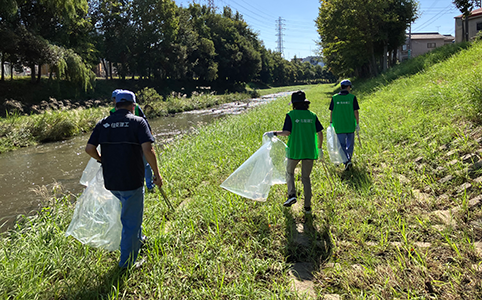
Location: Oyama River, adjacent to the Komaki Plant in Komaki City
Activities: Participation in local river cleanup activities, including vegetation management and litter collection along the riverbanks
Purpose: Maintaining and improving the river environment and reducing impacts on aquatic ecosystems
Results: Ongoing preservation of the river environment through continuous cleanup and vegetation management activities
Participants: 28 (FY2025)
Activities: Participation in local river cleanup activities, including vegetation management and litter collection along the riverbanks
Purpose: Maintaining and improving the river environment and reducing impacts on aquatic ecosystems
Results: Ongoing preservation of the river environment through continuous cleanup and vegetation management activities
Participants: 28 (FY2025)
Komaki City / Aquatic Life Survey near the Komaki Plant
As part of environmental education programs in Komaki City, elementary school students conduct surveys of aquatic organisms to assess local river environments. Sumitomo Riko has participated in this initiative every year by supporting surveys conducted in the Oyama River near the Komaki Plant. Since FY2025, the number of participating schools has increased to six, and the program has expanded beyond the Oyama River to include surveys in several rivers throughout the city.
During the surveys, our employees help students safely collect aquatic organisms and assist in identifying the species observed. We will continue working with the local community to support the conservation of river environments throughout the region.
During the surveys, our employees help students safely collect aquatic organisms and assist in identifying the species observed. We will continue working with the local community to support the conservation of river environments throughout the region.
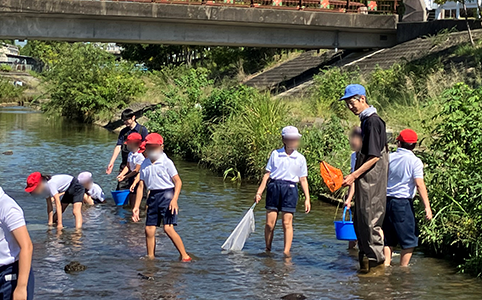
Location: Oyama River, Hatta River, and Aise River, Komaki City
Activities: Surveys of aquatic organisms, including insects and fish, to assess local river environments
Purpose: Assessing the health of aquatic ecosystems
Results: Improved understanding of local river environments based on the distribution of aquatic organisms and increased environmental awareness within the local community
Participants: 551 (FY2025)
Activities: Surveys of aquatic organisms, including insects and fish, to assess local river environments
Purpose: Assessing the health of aquatic ecosystems
Results: Improved understanding of local river environments based on the distribution of aquatic organisms and increased environmental awareness within the local community
Participants: 551 (FY2025)
Rayong Province, Thailand / Mangrove Restoration
Since 2014, SumiRiko Eastern Rubber (Thailand) Ltd. (SRK-ER) has carried out mangrove planting projects in Rayong Province and other areas of Thailand. Approximately 1,500 mangrove saplings are planted each year, and their survival and growth are continuously monitored.
Mangrove forests are important ecosystems that support biodiversity. As these forests continue to decline, SRK-ER contributes to their conservation and restoration, helping to maintain biodiversity while also reducing greenhouse gas emissions through CO2 absorption.
Mangrove forests are important ecosystems that support biodiversity. As these forests continue to decline, SRK-ER contributes to their conservation and restoration, helping to maintain biodiversity while also reducing greenhouse gas emissions through CO2 absorption.
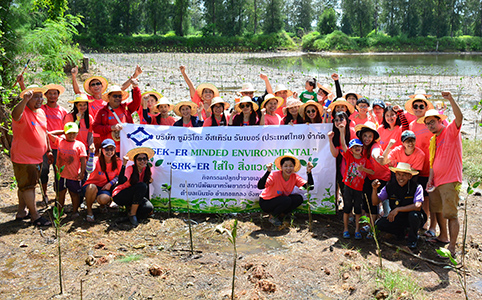
Location: Rayong Province, Thailand (coastal mangrove habitat)
Activities: Planting mangrove saplings
Purpose: Restoring coastal ecosystems and maintaining and enhancing biodiversity
Results: Approximately 1,500 mangrove saplings planted annually
Participants: 100 (FY2025)
Activities: Planting mangrove saplings
Purpose: Restoring coastal ecosystems and maintaining and enhancing biodiversity
Results: Approximately 1,500 mangrove saplings planted annually
Participants: 100 (FY2025)
Rare Species Conservation
Komaki City / Conservation of the Mamenashi Habitat
Mamenashi (Pyrus calleryana var. dimorphophylla) is a rare deciduous tree native mainly to the Tokai region of Japan. It is listed as Endangered IB on the Ministry of the Environment Red List and Critically Endangered IA in Aichi Prefecture’s Red Data Book. The tree blooms with white flowers from late March to early April and bears small pear-like fruits in autumn.
The Okusa Mamenashi Habitat, located in eastern Komaki City, is one of the largest natural habitats for Mamenashi in Japan. It is highly valued because it has long maintained an environment that supports natural regeneration and the long-term survival of the species. The site has therefore been designated as an Aichi Prefectural Natural Monument.
To preserve this valuable habitat for future generations, Sumitomo Riko works together with Komaki City, local volunteers, experts, and students on habitat conservation efforts.
The Okusa Mamenashi Habitat, located in eastern Komaki City, is one of the largest natural habitats for Mamenashi in Japan. It is highly valued because it has long maintained an environment that supports natural regeneration and the long-term survival of the species. The site has therefore been designated as an Aichi Prefectural Natural Monument.
To preserve this valuable habitat for future generations, Sumitomo Riko works together with Komaki City, local volunteers, experts, and students on habitat conservation efforts.
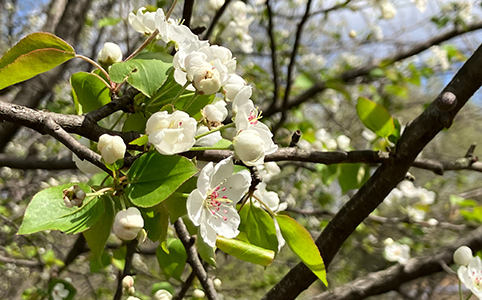
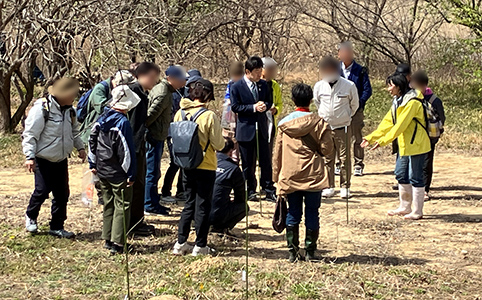
Location: Okusa, Komaki City
Activities: Seedling surveys, habitat maintenance activities such as grass cutting, habitat monitoring, and nature observation events
Purpose: Maintaining viable populations of this rare species and conserving habitat that supports natural regeneration
Results: Continued monitoring of mamenashi populations in their natural habitat and ongoing maintenance of habitat conditions
Participants: 213 (FY2025)
Activities: Seedling surveys, habitat maintenance activities such as grass cutting, habitat monitoring, and nature observation events
Purpose: Maintaining viable populations of this rare species and conserving habitat that supports natural regeneration
Results: Continued monitoring of mamenashi populations in their natural habitat and ongoing maintenance of habitat conditions
Participants: 213 (FY2025)
Invasive Species Removal
Komaki City / Lanceleaf Tickseed Removal and Distribution Survey
Since 2022, the Komaki Plant has conducted removal activities for lanceleaf tickseed (Coreopsis lanceolata), a designated invasive alien species. Because the species may negatively affect native ecosystems and can spread through seed dispersal, we regard its control as part of our responsibility to the local community.
Since FY2024, we have conducted distribution surveys around the Komaki Plant and mapped the results to better understand the species' distribution. Going forward, we plan to use these findings in collaboration with the city to develop removal programs that can also support environmental education for local elementary school students.
Since FY2024, we have conducted distribution surveys around the Komaki Plant and mapped the results to better understand the species' distribution. Going forward, we plan to use these findings in collaboration with the city to develop removal programs that can also support environmental education for local elementary school students.
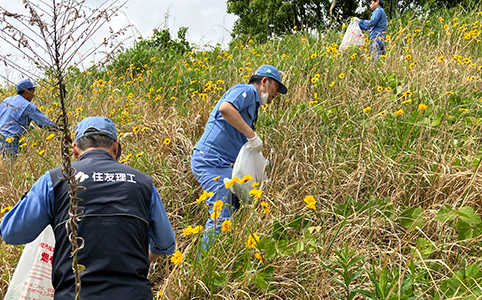
Location: Areas surrounding the Komaki Plant in Komaki City, including nearby green spaces and roadsides
Activities: Removal of lanceleaf tickseed, distribution surveys, and mapping of its habitat
Purpose: Preventing the spread of invasive species and conserving habitats for native plants
Results: Improved understanding of the species’ distribution around the plant and continued removal efforts
Participants: 87 (FY2025)
Activities: Removal of lanceleaf tickseed, distribution surveys, and mapping of its habitat
Purpose: Preventing the spread of invasive species and conserving habitats for native plants
Results: Improved understanding of the species’ distribution around the plant and continued removal efforts
Participants: 87 (FY2025)
Satoyama Conservation
The Sumitomo Riko Group collaborates with local governments and community members to engage in forest management and satoyama conservation efforts. Satoyama refers to traditional rural landscapes where people and nature have coexisted through the sustainable use and management of local natural resources. Our activities include various initiatives based on agreements and contracts with local authorities as well as participation in community organizations, all tailored to meet the unique needs of each location.
In addition to forest maintenance activities such as thinning and pruning, these initiatives foster connections between our employees and local communities and provide opportunities for environmental education.
In addition to forest maintenance activities such as thinning and pruning, these initiatives foster connections between our employees and local communities and provide opportunities for environmental education.
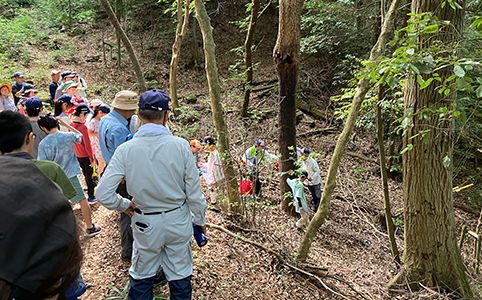
Komaki City / Management of Chigo no Mori Forest
Location: Chigo no Mori Forest, Komaki CityActivities: Forest maintenance through thinning and leaf litter removal
Purpose: Maintaining ecosystems and preserving landscapes in urban fringe areas
Results: Improved forest health
Participants: 38 (FY2025)
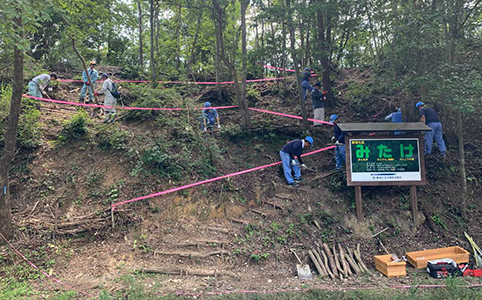
Mitake Town (Tokai Chemical Industries, Ltd.) / Management of Mitake Forest
Location: Mitake Forest, Mitake TownActivities: Forest maintenance through thinning, pruning, and undergrowth clearing
Purpose: Improving light conditions in the satoyama woodland and promoting the growth of native plant species
Results: Recovery of understory vegetation and improved habitat conditions for wildlife
Participants: 24 (FY2025)
Stakeholder Engagement
Komaki City Partnership Dialogue on Living in Harmony with Nature 2025
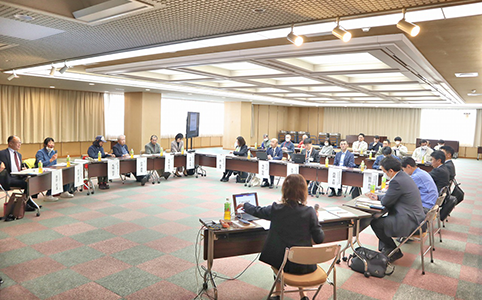
Since FY2023, Sumitomo Riko has hosted the Komaki City Partnership Dialogue in Komaki City, home to the Company's headquarters, to bring together stakeholders from business, government, civic organizations, and academia and promote nature-positive activities in the region.
Related Information
Northern Owari Ecosystem Network Council
In Aichi Prefecture, ecosystem network councils have been established in nine regions to promote regional biodiversity conservation through collaboration among universities, non-profit organizations, businesses, and government agencies.
As a member of the Northern Owari Ecosystem Network Council, Sumitomo Riko participates in activities to support the development of regional ecosystem networks.
As a member of the Northern Owari Ecosystem Network Council, Sumitomo Riko participates in activities to support the development of regional ecosystem networks.
Environmental Education Initiatives
Inuyama City / University Lecture on Living in Harmony with Nature
In June 2025, a Sumitomo Riko employee delivered a guest lecture at Nagoya University of Economics. Under the theme "Sumitomo Riko's Efforts Toward Realizing a Nature-positive Society," the lecture introduced the Company's activities related to living in harmony with nature.
This lecture was conducted as part of Sumitomo Riko's engagement with local stakeholders, including businesses, government agencies, civic organizations, and universities, aimed at promoting nature-positive initiatives in the region.
This lecture was conducted as part of Sumitomo Riko's engagement with local stakeholders, including businesses, government agencies, civic organizations, and universities, aimed at promoting nature-positive initiatives in the region.
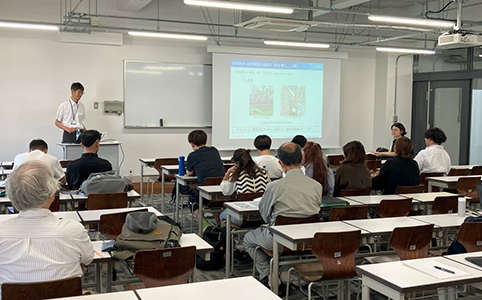
Location: Nagoya University of Economics
Activity: Guest lecture for the course “Introduction to Environmental Coexistence and Satoyama SDGs”
Purpose: Promoting understanding of a nature-positive society and raising awareness among future generations
Results: Deeper understanding of nature-positive initiatives through dialogue with students and faculty members, and strengthened regional collaboration
Activity: Guest lecture for the course “Introduction to Environmental Coexistence and Satoyama SDGs”
Purpose: Promoting understanding of a nature-positive society and raising awareness among future generations
Results: Deeper understanding of nature-positive initiatives through dialogue with students and faculty members, and strengthened regional collaboration
Natural Capital Conservation in the Supply Chain
The Sumitomo Riko Group is dedicated to reducing environmental impacts across our supply chain. Recognizing the importance of natural rubber to our products, we joined the Global Platform for Sustainable Natural Rubber (GPSNR) in July 2022 to promote sustainable natural rubber sourcing. Following this, we established the Procurement Policy for Sustainable Natural Rubber.
Related information
Related information
Biodiversity Certifications and Partnerships
Ikeda Town, Nagano / Sumitomo Riko Forest Registered as an OECM
The Omine-kogen Biodiversity Conservation Area, where Sumitomo Riko participates through Nagano Prefecture's Forest Foster Parent Program, was certified as a Nationally Certified Sustainably Managed Natural Site*1 in FY2024 and registered in the international OECM*2 database in FY2025. Located in the northern part of Ikeda Town, Kitaazumi District, Nagano Prefecture, the area covers approximately 116 hectares at an elevation of about 1,000 meters. Eighteen species listed on national and prefectural Red Lists have been recorded in the area.
As a member of the Omine-kogen Satoyama Management and Utilization Promotion Council, Sumitomo Riko supports the sustainable management of satoyama landscapes and biodiversity conservation.
As a member of the Omine-kogen Satoyama Management and Utilization Promotion Council, Sumitomo Riko supports the sustainable management of satoyama landscapes and biodiversity conservation.
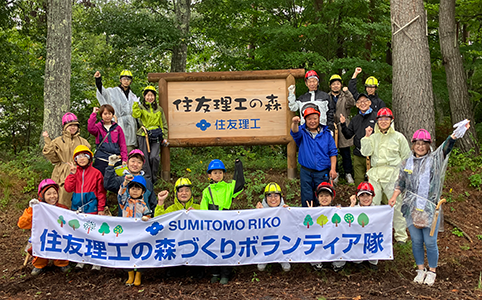
Location: Omine-kogen Biodiversity Conservation Area, Ikeda Town
Activities: Satoyama management (including undergrowth clearing and vegetation management) and participation in the local conservation council
Purpose: Conserving regional biodiversity and promoting the sustainable use of satoyama landscapes
Results: Designated as a Nationally Certified Sustainably Managed Natural Site by the Ministry of the Environment in FY2024 and registered in an international database as an OECM in FY2025
Participants: 46 (FY2025)
Activities: Satoyama management (including undergrowth clearing and vegetation management) and participation in the local conservation council
Purpose: Conserving regional biodiversity and promoting the sustainable use of satoyama landscapes
Results: Designated as a Nationally Certified Sustainably Managed Natural Site by the Ministry of the Environment in FY2024 and registered in an international database as an OECM in FY2025
Participants: 46 (FY2025)
*1 Nationally Certified Sustainably Managed Natural Sites are areas where biodiversity conservation is being achieved through private-sector and other stakeholder initiatives. The program contributes to the global 30by30 target, which aims to effectively conserve at least 30% of the world's land and sea areas by 2030.
*2 OECM stands for Other Effective Area-based Conservation Measures, referring to areas outside protected areas that contribute to biodiversity conservation.
*2 OECM stands for Other Effective Area-based Conservation Measures, referring to areas outside protected areas that contribute to biodiversity conservation.
Related information
Related information
Partnership Agreement with Komaki City for a Society in Harmony with Nature
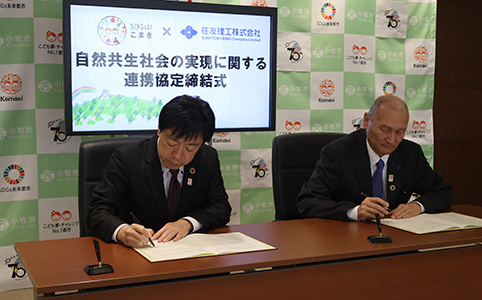
In February 2025, Sumitomo Riko entered into a partnership agreement with Komaki City, Aichi Prefecture, to promote the realization of a society in harmony with nature.
Based on this agreement, we are promoting collaboration on biodiversity conservation and the protection of local environments that serve as habitats for diverse species.
Based on this agreement, we are promoting collaboration on biodiversity conservation and the protection of local environments that serve as habitats for diverse species.
Related information
Aichi Biodiversity Company Certification (Master Certified Level)
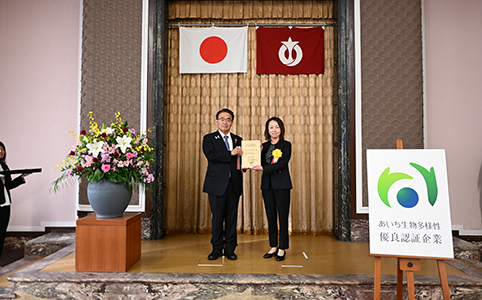
Aichi Prefecture operates the Aichi Biodiversity Company Certification Program, which recognizes companies demonstrating outstanding biodiversity conservation initiatives. Sumitomo Riko was certified as a "Master Certified Aichi Biodiversity Company" under the program in November 2025.
Related information
Related information
Participation in the Keidanren Initiative for Biodiversity Conservation
In March 2024, as part of its commitment to biodiversity conservation, Sumitomo Riko joined the Keidanren Initiative for Biodiversity Conservation, organized by the Keidanren Nature Conservation Council. Through this initiative, we are implementing the actions set out in the Keidanren Declaration for Biodiversity and Action Guidelines (Revised Edition) and supporting its overall objectives.
Related information
Future Issues and Responses
The Sumitomo Riko Group will continue to deepen employees' understanding of how our business activities depend on and impact natural resources, ecosystems, and biodiversity. We will raise awareness across the organization of these impacts and the actions needed to address them. By doing so, we aim to embed nature-positive initiatives into our business activities and foster a shared sense of responsibility among all employees. Building on this understanding, each site will establish action plans tailored to local characteristics and advance initiatives that reflect local needs.
Furthermore, we will address the environmental impacts associated with raw materials and components and promote nature-positive practices throughout our value chain.
Furthermore, we will address the environmental impacts associated with raw materials and components and promote nature-positive practices throughout our value chain.
